FAQ on Belgian savings accounts
Answers to the most common questions about savings accounts and fixed-term deposits.

Frequently asked questions
FAQ on Belgian savings accounts
What is the concrete difference between a savings account and a fixed-term deposit?+
A regulated savings account (passbook) stays liquid: you withdraw whenever you want, no penalty. The rate is variable — a base rate plus a fidelity premium the bank can adjust. A fixed-term deposit instead locks the capital for 3 to 60 months in exchange for a fixed rate, known at signing and usually higher. In short: flexibility on one side, locked-in yield on the other.
Savings account or fixed-term deposit — which one?+
Precautionary savings, unclear horizon, need for availability: the savings account. Money you're sure you won't need for 12, 24 or 36 months: the fixed-term deposit, better paid. In practice many savers combine both — a liquid buffer on a passbook, the rest on laddered fixed-term deposits to spread maturities.
How is interest on a regulated savings account calculated and credited?+
The base rate accrues day by day on every euro deposited. The fidelity premium is earned only on amounts that stayed 12 consecutive months on the account. Interest is credited once a year, typically on January 1. Withdrawing before the 12-month anniversary wipes the pending premium on the withdrawn portion.
Does the ~€1,020 interest tax exemption also apply to fixed-term deposits?+
No. The exemption on the first tranche of annual interest per taxpayer (amount revised yearly, around €1,020 in 2026) applies only to regulated savings accounts that meet the criteria of Article 21 of the Belgian Income Tax Code. On a fixed-term deposit the 30% withholding tax applies from the first euro of interest.
What is a savings account?+
A savings account is a banking product that lets you deposit money and receive interest in return, generally higher than on a current account. In Belgium it takes the form of either a regulated passbook (available at any time) or a fixed-term deposit (capital locked for a fixed duration).
What is the difference between a savings account and a fixed-term deposit?+
On an on-demand savings account (passbook), funds remain available at any time and the rate combines a base rate plus a fidelity premium. On a fixed-term deposit, capital is locked for an agreed duration (3–60 months) in exchange for a higher interest rate known from opening.
Are Belgian savings accounts safe?+
Yes. All savings accounts and fixed-term deposits at Belgian licensed banks are covered by the Guarantee Fund for Financial Services, which protects each depositor up to €100,000 per bank in case of failure.
What is the taxation of interest in Belgium?+
Interest on fixed-term deposits is subject to the 30% withholding tax, deducted at source. On a regulated passbook, the first tranche of annual interest per holder is exempt; above it, a reduced 15% withholding tax applies.
Can I open a savings account at a foreign bank?+
Yes. Thanks to free movement of capital in the European Union, a Belgian resident can open a fixed-term or savings account at any EU bank, benefiting from the origin country's guarantee fund, equivalent to the Belgian Fund.
Are European accounts guaranteed like Belgian ones?+
Yes. All EU countries apply directive 2014/49/EU, which guarantees deposits up to €100,000 per depositor per bank. For non-EU countries (UK, Switzerland, Norway) specific national rules apply.
What are the best 12-month fixed-term deposits in Belgium?+
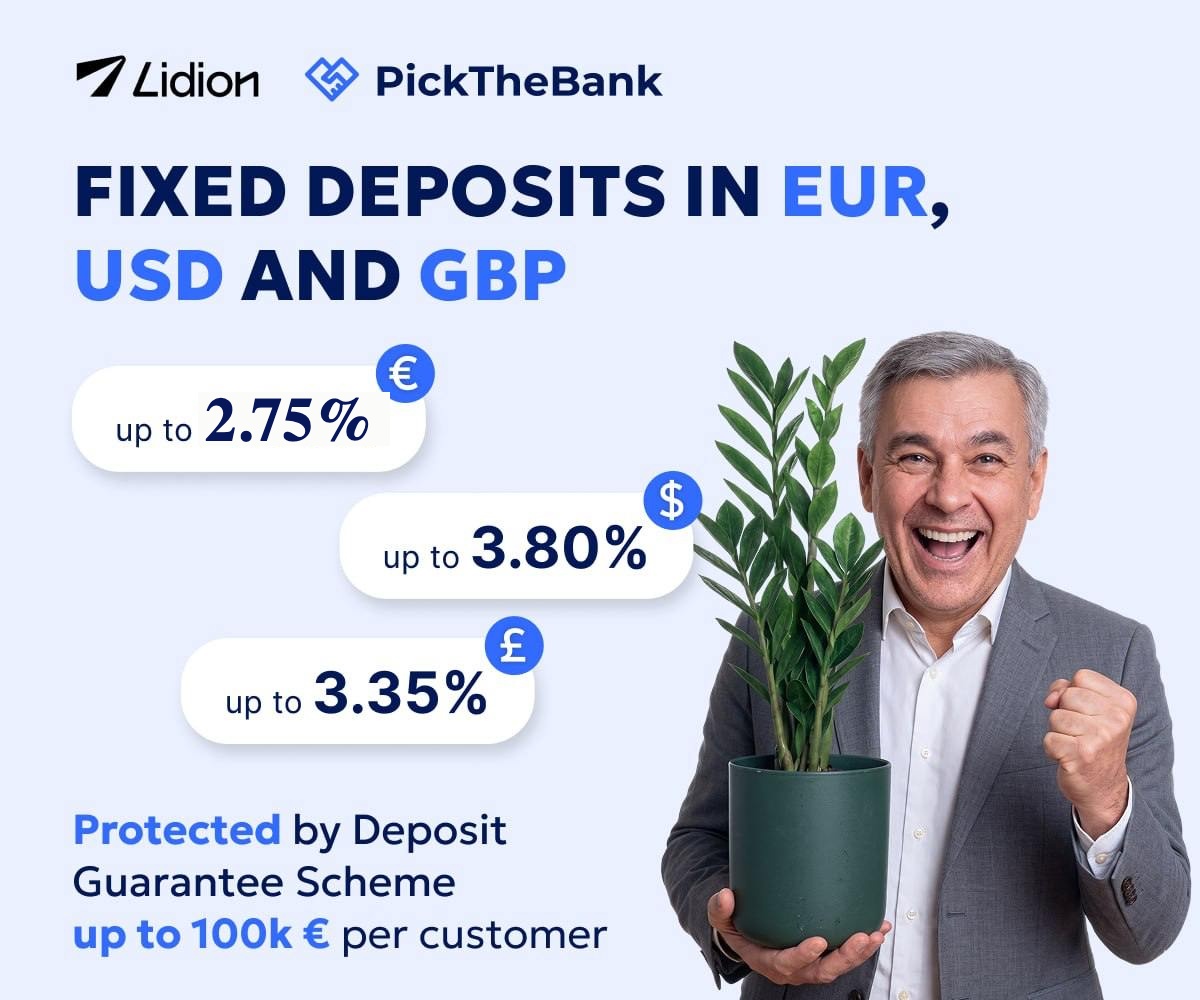
In 2026, the best 12-month offers in Belgium range from 1.50% to 2.90% gross, with notable proposals at vdk bank, Santander Consumer Bank Belgium and several European banks accessible from Belgium (Lidion Bank, Trade Republic, bunq).
Is a 24- or 36-month fixed-term deposit worth it?+
Longer terms generally offer a higher rate. They suit savers who do not need the capital in the short term and want to lock in a stable yield, sheltered from market swings.
Can I withdraw money from a fixed-term deposit before maturity?+
It depends on the contract. Some banks allow early withdrawal with partial or full loss of accrued interest; others forbid it outright. Always check this clause before signing.
What net yield can I really expect?+
The net yield is obtained by subtracting the 30% withholding tax from the gross rate. A fixed-term deposit at 3.00% gross yields around 2.10% net. On a regulated passbook, effective taxation is lower as long as you stay within the exempt tranche.
Can I open several savings accounts at the same time?+
Yes, there is no legal limit. Spreading savings across several licensed banks also lets you stay within the €100,000 guarantee limit per bank while capturing the best market conditions.
Do I need a current account to open a savings account?+
Generally yes: the savings or fixed-term account is linked to a reference current account — Belgian or European — from which the initial deposit is made and to which repayment at maturity is credited.
What documents are needed to open a savings account online?+
A valid ID (Belgian eID or passport), a national register number and the IBAN of a current account. Identification is usually done via itsme, eID or video identification.
Are savings rates fixed or variable?+
On a fixed-term deposit the rate is fixed for the entire contract. On a regulated passbook, the base rate and fidelity premium can be changed unilaterally by the bank, subject to prior notice.
Is a fixed-term deposit better than a Belgian State Note?+
The fixed-term deposit guarantees capital up to €100,000 and offers a known fixed rate. The Belgian State Note is also very safe and can offer a competitive yield, but taxation may differ by issue (sometimes reduced withholding). The choice depends on your horizon and any need to recover funds before maturity.